Finally you get a job that sounds right for you. You have your resume ready, the job matches your skills and then you see one more requirement: cover letter.
That’s where the application suddenly seems harder for many job seekers.
You know why you want the job, but getting that reason into the right words isn’t always easy. So you open an AI tool and paste in the job description and ask it to write you something. You have a polished AI cover letter in seconds.
It looks professional The grammar is flawless. OK.
But then you read it again.
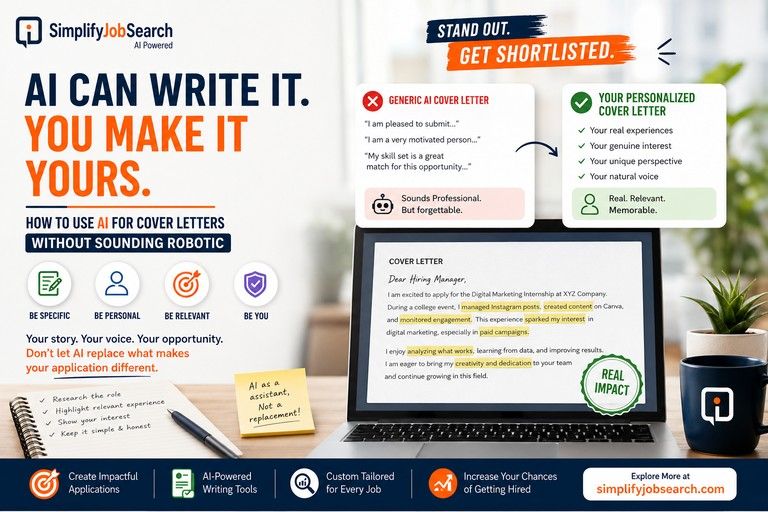
“I am pleased to submit…”
“I am a very motivated person…
“My skill set is a great match for this opportunity…
The letter sounds fine, but it could be from nearly anybody.
That’s the real problem with AI for cover letters in 2026. Artificial intelligence can help you get past a blank page, but it can’t automatically understand why this particular role is meaningful to you.
We’re not trying to dodge AI. use it, without losing your own voice.
What’s an AI Cover Letter?
AI Cover Letter means a Cover Letter draft created or enhanced using Artificial Intelligence.
You can upload your resume, the job description, your skills, the company name and some information about your experience to the tool. The tool takes that data and produces a first draft.
This can be useful if you know what you want to say, but have difficulty in structuring it.
Artificial intelligence can help you organise your thoughts, improve your grammar, make your sentences clearer or match your experience to the job requirements.
The University of Michigan Career Center says artificial intelligence can provide writing guidance, tailoring, grammar, consistency and writer’s block. At the same time, it stresses that a strong cover letter should still be personalised and creative.
That’s important balance.
AI is able to assist you in writing the letter. It is not to tell you what your story is.
Are AI Cover Letters Still Worth It in 2026?
Yes, but it depends how you use them.
According to a recent study by Tilburg University that looked into the function of large language models in cover letters, artificial intelligence can improve the quality of cover letters. But the university’s 2026 research summary also said this improvement didn’t necessarily improve a person’s chances of getting hired. Recruiters still noted personal motivation and writing clarity.
This is helpful for job seekers to understand.
A better written letter can be an advantage, but it does not make a better application if the letter does not tell the recruiter anything meaningful about you.
Imagine AI as someone coming to help you clean up your desk before an important meeting. It can be more efficient and make things clearer but you still have to be there and speak for yourself.
Why Generic AI Cover Letters Can Be Bad for Your Application
1. They Sound Like Everyone Else
AI writing in general tends to have sentences that sound professional, but say nothing.
“I am excited about the opportunity.”
“I am a results-oriented professional.
“I think I would be a perfect fit for your team.
None of these sentences are wrong per se . The problem is they don’t tell you what you care about.
Your letter should tell a recruiter something he can’t see from your resume.
Maybe you landed in marketing because you promoted a college event. Maybe you liked solving customer problems as an intern. Perhaps a Python project sparked your interest in data analysis.
These details make this your letter.
2. AI Doesn’t Know Your Reason Unless You Tell It
If you ask me,
“How to Write a Cover Letter for a Marketing Job”
There is very little for the AI to work with.
Typically, it’ll fill in the blanks with safe, generic language.
Now contrast that with:
Write a cover-letter draft for a digital marketing internship. Assisted with managing Instagram posts for a college event, created content on Canva, and monitored engagement. I’d like to know more about paid campaigns. Keep it simple and don’t add any experiences I haven’t had.
Second request gives the AI something real to work with.
The more information you give a cover letter generator, the more useful it will become.
3. AI Might Add Stuff You Never Did
This is one of the most important reasons to review every AI-generated application thoroughly.
An AI tool could make your experience sound more impressive than it really is. Sometimes it will even add in achievements or responsibilities that you never said.
Pretend your letter says:
“Targeted campaigns generated a 40% increase in social media engagement.”
Sounds good.
But what if you never measured that result? What do you say when the interviewer asks you how you achieved the 40% increase?
A polished sentence is no point if it costs and awkward interview.
You should be able to tell the truth about every skill, result, project, and achievement in your AI cover letter.
4. Too much polish can kill your personality.
Freshers often think they have to sound super formal to impress employers.
They don’t.
Being professional doesn’t mean sounding like a corporate press release.
Don’t write:
“I’m passionate about delivering meaningful outcomes for organisations thru innovative digital approaches.
You could just say:
“Being involved in marketing a college event on Instagram inspired my interest in digital marketing. “I liked planning content and seeing what posts students responded to.
The second version is more understandable, more believable, and easier to discuss in an interview.
Simple is not inferior.
How to Properly Use an AI Cover Letter Generator
Before asking AI to write any content, start with your real data.
Have your resume and full job description in front of you. Look for the skills the employer is looking for and think about where you have actually used those skills.
Then pick one or two experiences that are worth mentioning.
It can be an internship, college project, volunteer activity, freelance task, certification project, part-time job, personal project, etc.
When AI gives you a draft, don’t copy and send it immediately.
You should first read the opening.
Ask yourself if that first paragraph could be sent to 50 other companies without changing anything. If the answer is yes, then change it.
Then, look at the center of the letter. Include at least one real-world example that ties your experience to the job.
Finally, read the entire letter out loud.
If you have words that you would never normally use, replace them.
If a sentence sounds too formal, make it simple.
Remove it if AI added something that is not true.
Your final application should sound like a better version of you, not a different person.
Sample AI Cover Letter: General Vs Customised
Here is a typical generic:
I am very excited about the chance to apply for the Digital Marketing Intern position. I am a highly motivated person with excellent communication and marketing skills. I have no doubt that I would be a good fit for your organization.
There’s nothing technically wrong with it.
“But we still know very little about the candidate.”
Here’s a more personal take, now:
I got interested in digital marketing while helping to promote a college event on Instagram. I created posts in canva, helped plan the content schedule and loved seeing how different types of content affected engagement. That experience is part of the reason I’d like to keep growing my abilities by doing this internship.
With this version the recruiter has something tangible.
It explains the interest rather than simply stating the interest.
Are Cover Letters Written by AI Detectable by Recruiters?
“Recruiters can always tell if something was written by AI. There’s no way you can reliably say that.
And “hiding” AI should not be your chief concern.
The bigger problem is writing that is generic.
A recruiter can spot a letter that makes vague claims, uses repetitive corporate phrases, lacks personal motivation or uses language that is completely different from the candidate’s resume and interview communication.
Artificial intelligence can help improve the quality of cover letters, but recruiters appreciate personal motivation and clarity, new research by Tilburg University suggests.
So, instead of asking, “How do I make sure nobody will know I used AI?” ask a better question:
Is this letter really me?”
When to send a cover letter?
Not all job applications ask for one.
Generally, you want to include one if the employer asks for a cover letter.
It can also help when your resume doesn’t tell the whole story. Maybe you are making a career change. You might not have a lot of work experience, but you have a good reason for wanting the job. You can also talk about why you are interested in a particular company or industry.
Your cover letter should add context, not regurgitate your resume. Career guidance at Tilburg University also refers to a motivation letter or cover letter as an addition to the CV, in which candidates can explain their motivation, knowledge and skills.
Your resume tells what you did. Your cover letter tells why it matters for the job you want to do next.
Common Errors to Avoid in AI Cover Letters
Here are some common problems to look out for before you send your letter:
- Using the first draft from the AI, without editing
- Writing a letter with no job description
- Sending the identical letter to different companies
- Lying About Skills or Accomplishments
- Rewriting Your Entire Resume
- Using complicated words to sound professional
- Not saying why you are interested in the role
- Not including the right company or job title in the letter
- That makes the letter longer than it needs to be.
AI is able to write something in seconds.
Investing a few extra minutes to personalise that draft can make a huge difference to the final application.
How To Simplify Job Search May Help You
The start is often the most difficult part, particularly if you have spent time updating your CV and filling in application forms.
Simplify Job Search’s AI Cover Letter Generator creates a first draft tailored for you from your resume and the job description you are targeting. “Then you can check the tone of the text, edit the wording and add your own opinion before submitting it.”
The point is not to have AI speak for you.
To make the starting point easier.
If you’re using AI elsewhere in your job search, read our guide to AI job search tools in 2026.
See the University of Michigan Career Center’s cover letter resources for more tips on how to use AI responsibly in cover letters, including where artificial intelligence can help you and why personalisation is still needed.
Final Conclusion
An AI cover letter can save you some time. This can be useful when you are staring at a blank screen and do not know how to start. It can help with grammar, structure and clarity.
But that should not detract from the part of the application that only you can provide.
Your reasons for applying for the job.
Your project.
Your expertise.
Your inquisitiveness.
Your voice.
You may continue to use AI.
Use it to begin. Use it to sort your thoughts. Use it to clarify vague sentences.
Then read the letter again and take ownership of it.
Your cover letter doesn’t have to be perfect.
It needs to sound like a real person is behind it.”