





There was a lot of redundancy in the hiring process.
A recruiter could spend hours sifting through resumes, sending out emails, booking calls, looking at applications, updating spreadsheets, and trying to keep track of dozens of people at once.
And when hundreds of people apply for a single job?
That makes the workload even harder.
That’s how recruiting by AI is changing the game.
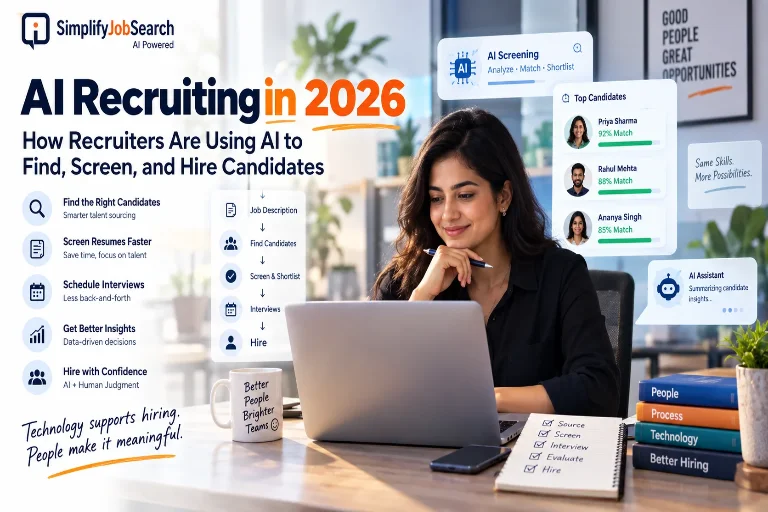
Now, artificial intelligence can help recruiters find candidates, read resumes, write job descriptions, screen applicants, schedule conversations and organise information before a human recruiter makes the next decision.
That’s fine.
But there’s also an important question:
How much of recruiting should AI be doing?
The answer is not just “everything.”
Artificial intelligence can speed up hiring, but recruitment is still a people business. A resume doesn’t tell the full story. A candidate may have transferable skills that are not quite keywords. Sometimes a recruiter needs context that a machine can not understand.
So the most useful thing to do in 2026 is not to replace recruiters with AI.
It’s leveraging AI to take away the repetitive work, while keeping the important hiring decisions human.
Here’s what that looks like.
Artificial intelligence recruiting
Artificial intelligence recruiting is the use of artificial intelligence (AI) tools to support and automate parts of the recruiting process.
AI recruiting is where you use artificial intelligence to help you with various aspects of the recruitment process.
AI may help with: Depending on the tools a company is utilising,
- Job description
- Search for potential candidates
- Matching resumes to job descriptions
- Screening applications
- Initial screening questions
- Interview Scheduling
- Summary of candidate data
- Experience and Skills
- Recruiter report generation
- Helping with interview preparation and assessment
Not every company utilises AI in the same manner.
Some recruiters may just use AI to write a job description.
AI may be used through the hiring process.
The difference is that AI is used as a support system, not as a replacement for human judgement.
So why are recruiters turning to AI?
Recruiters have a simple problem.
Often, too many applications and too little time.
A recruiter might need to go through hundreds of resumes for one position, manage current candidates, schedule interviews, reply to emails and work with hiring managers.
According to SHRM’s 2026 recruiting research, recruiting leaders expect to see more use of AI in different facets of recruiting, including candidate applications, interviews, feedback, updates and candidate communication.
That’s not to say recruiters want fewer humans in the loop, necessarily.
It means they need help with the time-consuming stuff that doesn’t require a lot of human judgement.
The story is about a man who is a master craftsman and he’s trying to find out who’s been sabotaging his work.
“It takes a lot of time to read 500 resumes manually.
A structured shortlist with clearly defined requirements can free up the recruiter to spend more time actually evaluating candidates.
That’s where standard artificial intelligence can help.
7 Ways Recruiters Are Leveraging AI in 2026
1. Improved Job Descriptions
It takes time to write a good job description.
The recruiter needs to clarify the position, responsibilities, qualifications, skills, expectations and other important information.
AI is able to write a first draft, given a job title and requirements.
The recruiter can then review it, take out any unnecessary requirements, add company specific information and make sure the description accurately describes the position.
This is a good example of AI doing the repetitive first draft and the recruiter responsible for the final result.
2. Finding the Right Candidates Faster
Candidate sourcing can be one of the most time consuming parts of recruiting.
Recruiters may search professional networks, internal databases, job boards, referrals and previous candidates.
Artificial intelligence can help find candidates with skills, experience, job history and other information that seem relevant to the role.
Instead of starting with hundreds of profiles, the recruiter can start with a smaller group of possibly relevant candidates.
But there is an important caveat.
A good candidate is not always the one with the best keyword match.
Someone may have the right transferable skills but use different terminology in their resume.
So recruiters still need to factor in the context.
3. Resumes Screening
Resume screening is probably the area where artificial intelligence can save recruiters the most repetitive work.
AI is able to match a candidate’s resume to the requirements for a particular role and identify:
- Related skills
- Work History
- Experience & Qualifications
- Requirements not found
- Possible issues
- Areas worthy of further questions
It can help recruiters to filter out a huge number of applicants.
But the AI output should be seen as information to be reviewed, not as an unchallengeable hiring decision.
SHRM recently warned about the risk of recruiters becoming too comfortable with algorithmic hiring decisions, particularly when automated systems start to influence candidate ranking and screening without sufficient human supervision.
4. Initial Candidate Screening
And this is where AI recruiting gets really interesting.
An AI system can also do an initial structured screening, rather than a recruiter spending the first part of every call asking the same basic questions.
For example, the system might enquire about:
- Work History
- Related expertise
- Work
- Availability.
- Knowledge specific to a role
- Claims to resume
The recruiter then collates the candidate’s responses into a report.
This doesn’t have to replace the recruiter.
It can just help the recruiter to decide:
Who do I speak to for the next 30 minutes?”
That’s a very different use of AI than letting an algorithm make the final hiring decision.
5. Interview Scheduling & Candidate Communication
Recruiters spend an incredible amount of time coordinating calendars.
One person free Monday.
Another Tuesday.
The hiring manager will be out travelling Weds.
The candidate asks for another date.
AI-driven scheduling and automated communication can help to reduce some of this back-and-forth.
AI may also help to send:
- Interview alerts
- Status updates
- Message scheduling
- Application confirmations,
- Follow-up alerts
According to SHRM’s 2026 research, 69% of surveyed recruiting executives expect automated updates and notifications to be more common and 67% expect the use of AI-powered chatbots and virtual assistants for customised candidate experiences to be more frequent.
To candidates, that could mean fewer times when they’re left wondering:
“Did they forget my application?”
6. Generating structured Candidate Reports
Recruiters have a lot of information stored in various places.
- Summary.
- Notes from Interview
- Answers screening.
- Recruiter’s perspective.
- Results of the Assessment.
AI is able to then take that information and produce a structured summary.
A useful report might point out:
- Related experience
- Advantages
- Worries
- Skills
- Screening replies
- Questions for follow-up:
- Areas to check out
The advantage is not just that the report is shorter.
The upside is that the recruiter sees the important information sooner.
That can help make the next conversation about hiring more focused.
7. How to Get Recruiters to Ask Better Questions
Artificial intelligence can also support recruiters to prepare follow-up questions.
Imagine a resume that reads:
“Directed migration of legacy application.”
Rather than ask another generic question, AI could suggest:
“Which part of the migration belonged to you?”
or else:
What was the biggest technical challenge you faced during the migration?”
Now the recruiter can use the interview to verify the candidate’s actual experience.
This is where standard artificial intelligence can be particularly handy.
It doesn’t have to take the place of the conversation.
It might make the dialogue better.
Can AI Recruiters Replace Recruiters?
Not necessarily.
A more realistic change is that the recruiter’s job may shift away from repetitive administration and toward judgement.
Think of the difference.
Classic workflow
Post Job → Receive Applications → Review Resumes → Schedule Calls → Ask Basic Questions → Take Notes → Shortlist
AI- assisted workflow
Post Job → AI Support → Structured Shortlist → AI Screening → Recruiter Review → Focused Interview → Hiring Decision
The recruiter is still a thing.
They just use their time differently.
They can spend less time on repetitive screening and more time getting to know candidates, working with hiring managers, improving the hiring process and making better decisions.
The Greatest Danger: Too Much Trust in AI
There are risks to AI recruiting, too.
An AI system can only do what the information, rules, data and design behind it allow.
If they are bad, then the output can be bad too.
An automated screening system, for example, might mistakenly penalise a candidate depending on how their experience is framed.
SHRM’s 6th guidance specifically warns employers using AI-enabled selection systems to validate those systems, as automated processes can create discrimination risks.
There is one more problem:
Artificial intelligence is able to create a false sense of certainty.
A recruiter sees a score of 87 and may reasonably think this candidate is better than a candidate with 72.
But what made that score?
What evidence was looked at?
What did we miss?
A number can appear objective even when the process behind it needs to be scrutinised carefully.
This is why AI should supplement recruiter judgement and not quietly replace it.
Candidates need transparency too
There’s another side to AI recruiting.
Job seekers are increasingly encountering AI when they apply for jobs.
In Greenhouse’s 2026 Candidate AI Interview Report, 63% of job seekers surveyed said they had been interviewed by AI, but many candidates expressed concern around transparency around how AI was used.
This offers a simple lesson for recruiters:
Tell us if AI is involved in your hiring process.
People are more likely to trust a process if they understand what’s happening.
Say to them:
- Where AI is used
- What the AI is judging
- If a human verifies the result
- What comes after the AI phase
- How they can enquire about the process
Technology doesn’t have to mean a bad candidate experience.
Uncertain technology can.
What to do with AI and what to do with the recruiters?
Here is a simple way to see it:
| Recruiter Should Own | Can Help With AI |
|---|---|
| Resume organization | Final candidate evaluation |
| Drafts of job descriptions | Role requirements |
| Candidate matching | context and exceptions |
| First screening | More detailed candidate assessments |
| Candidate management | Interview scheduling |
| Report generation | Hiring decision |
| Repeated communication | Sensitive conversations |
| Further recommendations | Final interpretation |
But this is not a hard rule for all companies.
Different organisations will have different work flows.
But it offers a useful principle:
Let AI do the boring stuff. Come on humans, get out of the context, responsibility and empathy decisions.
How Simplify Job Search Is Creating AI For Recruiters
That’s where the idea behind Simplify Job Search’s recruiter platform nicely fits.
There should be no need to repeat the same first-round screening process manually for each candidate who is shortlisted.
SJS AI Screening helps recruiters invite shortlisted candidates for an AI-led screening round with a structured report of screening scores, resume-claim validation, observations, follow-up questions and proctoring context.
The workflow is simple:
Shortlist → Send AI Screening Invite → Candidate completes screening → Review report → Decide next step
Not all candidates are candidates for automated evaluation. The key point is that AI screening happens after the first pass.
This keeps the workflow on track.
It gives more information to the recruiters before they waste time on another live screening call.
Discover SJS AI Screening for Recruiters
The Future of AI Recruiting Is Not “AI VS. Recruiter”
It’s easy to talk about the AI in terms of companies having only two choices:
Use AI/ML
or this
Use Humanz
Real hiring is more complex.
Artificial intelligence can be used by a recruiter to reduce repetitive work, but still have a very human hiring process.
A candidate can go through an AI screening and still have a meaningful conversation with a recruiter afterward.
The best workflows will likely be a combination of both.
AI is able to help answer,
“What information should I be looking at?”
The recruiter may then respond:
What does this information really mean for this person and this role?”
That’s an important distinction.
Because hiring is more than just matching skills to keywords.
It’s about understanding people, experience, potential, communication and whether the opportunity makes sense for both sides.
Conclusion
AI recruiting is changing the hiring landscape in 2026.
Recruiters are using AI to write job descriptions, find candidates, screen resumes, do first assessments, schedule interviews, organise candidate information and reduce repetitive work.
This can speed up hiring.
But faster doesn’t necessarily mean better.
A recruiter who just trusts an AI score blindly can still make a bad decision.
A recruiter who uses AI to help organise information, and then uses human judgement, could potentially spend more time on the parts of hiring that actually need human attention.
So the future of recruiting is not about taking people out of the process.
It’s about taking some of the unnecessary work away from the people who are already doing the hiring.”
And maybe that’s the most useful way to think about AI in recruitment:
Let AI do the repetition. Let the recruiters talk to the people.
Frequently Asked Questions
What is an AI recruiter?
AI recruiting is the use of artificial intelligence in various stages of the hiring process including writing job descriptions, identifying potential candidates, screening resumes, matching candidates to jobs, scheduling interviews, candidate screening, and reporting by recruiters.
How do recruiters use AI in 2026?
So, recruiters are increasingly using AI to save time on mundane tasks such as sifting through hundreds of applicants, matching candidates to job requirements, scheduling interviews, putting together candidate summaries, and conducting structured first-round screening.
Will AI replace recruiters?
Artificial intelligence can help automate some of the recruiting, but doesn’t necessarily replace the need for human recruiters. Hiring decisions are often based on context, communication, judgement, and understanding of information that may not be fully captured in a resume or automated score.
Is AI Recruitment Reliable?
Accuracy depends on the system, the data, the role requirements, and the use of AI. AI outputs should be reviewed by qualified people, especially when they affect the selection of candidates.
Can AI screening do less work for recruiters?
Yes . AI screening can handle structured initial questions and structure candidate responses so recruiters receive the information before they spend time on live screening conversations. This workflow is the backbone of SJS AI Screening.
The question of whether AI recruiting is fair
The question of whether AI recruiting is fair is a complex one. On one hand, artificial intelligence can help to automate certain aspects of the hiring process, such as screening resumes and scheduling interviews. This can save time and money for employers and reduce human bias. However, there are also concerns that artificial intelligence can perpetuate existing biases and discrimination in the hiring process. For example, if an AI system is trained on data that reflects historical biases, it may perpetuate those biases in its decisions. Additionally, there are concerns about the transparency and accountability of artificial intelligence systems, particularly in terms of understanding how they make decisions. Overall, while AI has the potential to improve the fairness of recruiting, there are also significant challenges and risks that need to be addressed. It is important to carefully consider the ability to AI on recruiting and to take steps to ensure that it is used in a responsible and ethical manner.
Using an AI system for recruiting does not automatically make it fair. Employers need to audit their AI-powered selection processes and watch out for possible discriminatory effects.
Should candidates be informed about being assessed by AI?
Transparency is more important than ever. Candidates should be clear on where AI is involved and how its output is used. Recent research from Greenhouse found that a lack of transparency around AI interviews was a top candidate concern.