You open a job portal and begin searching.
You enter your job title.
There are hundreds of jobs.
Then you start filter.
Location Experience. Pay. “Remote. Abilities.
20 minutes later, you’ve created a couple of jobs.
You continue looking for another hour.
And then you start to wonder:
“Are any of these jobs a good fit for me?”
That’s the problem an AI job-finder is trying to address.
AI is able to look at your skills, experience, preferences and a job’s needs to find openings that could be a better fit, instead of just showing you thousands of job postings.
The idea seems easy.
But finding a job that seems relevant is not the same as finding a job that fits.
A job will mention JavaScript but you have experience with TypeScript and Angular.
Your resume says you built Power BI dashboards, but someone else might ask for “visualising data.”
Traditional keyword searches might not understand that these experiences are related to each other.
AI job matching is able to perceive the meaning behind the information, not just if the exact words appear.
That’s where it becomes interesting.
What is an AI Job Searcher?
An AI job finder is a job search tool that uses artificial intelligence to help identify job opportunities that may be a good fit for a candidate’s profile.
Depending on the tool it might look at things like:
- Your talent
- Job experience
- Job Title
- Projects & Publications
- Education
- Place
- Desired work type
- Level of experience
- Job Desires
- Salary expectations
It can then compare this information with job descriptions and suggest roles that appear to fit.
This is not the same as simply searching:
“Position: Frontend developer”
and browsing through every listing that contains the words “frontend developer.”
An AI job finder attempts to figure out why a specific job may be a good fit for you.
That’s important.
The Drudgery of Old School Job-Searching
Most of us job seekers have been there.
You’re looking for one role.
And then another.
Then another.
You get a job.
Read the requirements.
Check location.
Check out the experience.
Back.
Create a new job.
Repeat.
So after an hour of this you’ve looked through 50 jobs and only found three that make any sense.
And there is another difficulty.
The language used in job descriptions and on resumes are not always the same.
A company might say:
“Building responsive web application experience.
Your resume might read:
“Developed Angular applications for customer facing platforms.
The wording may be different, but the meaning is closely related.
A 2026 paper in Information Sciences explores AI-driven semantic job matching as a means to move beyond traditional keyword matching and gain a better understanding of contextual relationships between job requirements and candidate profiles.
That’s the basic idea behind AI job matching.
How AI works for job matching?
You don’t need to know the technical side to use an AI job finder, but it helps to know the basic process.
Here’s a simplified AI job-matching process:
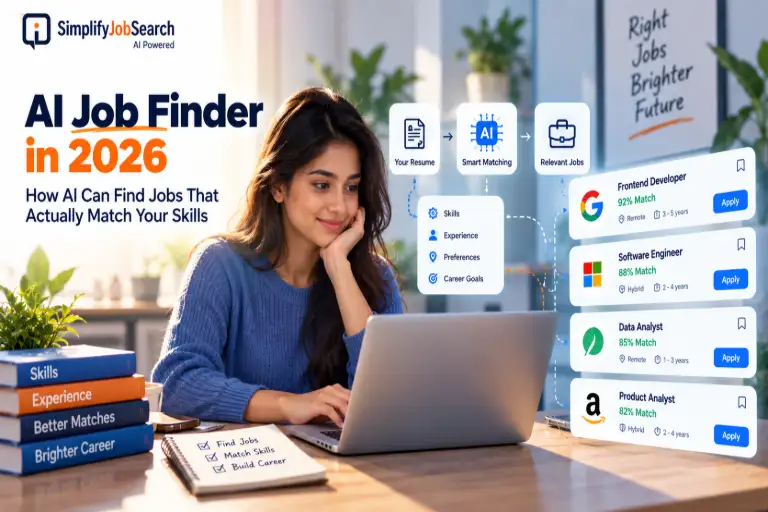
Your Resume -> Skills & Experience -> Job Requirements -> AI Matching -> Related Jobs
It may be that the system pulls data out of your resume first.
e.g.
Résumé
- AngularJS
- TypeScript
- JavaScript
- REST Web APIs
- 3 years of experience
- E-commerce projects
Then it reads a job description.
Work
- Front-end development
- Angular 2+
- TypeScript
- API connection
- 2-4 years experience
- E-commerce experience is a plus
Then the system can identify some areas of agreement.
But then the fun starts when the wording is different.
Let’s say the job says:
“Create web applications that can scale.”
And your résumé says:
“Developed and maintained large scale Angular applications.
A semantic matching system might recognise that these statements are similar, even if they do not contain the same words.
It can be tough with that simple keyword matching.
AI Job Search vs. Traditional Job Search
The difference is easier to see when you put the two approaches side by side.
| Traditional Search | AI Job Seeker |
|---|---|
| Search by keywords | Knows the profile and job context |
| Large number of results | Can prioritise potentially relevant jobs |
| Exact words matter more | Similar meaning can matter |
| Manually filter candidates | AI is able to help filter & match |
| Time-consuming | Can remove repetitive searching |
| Candidate assesses relevance from first principles | AI offers a relevance baseline |
That doesn’t mean traditional search is dead.
Sometimes you know what you want.
If you want to search for a specific company, role, location or technology, normal search can be very useful.
AI gets more interesting when your needs are broader, or when your experience doesn’t align perfectly with the language of the job description.
6 ways an AI job finder can help you
1. Discover Jobs Based on Your True Skills
Instead of starting with a job title, start with what you know.
You might have:
- Python
- SQL
- Ms. Excel
- Power BI
- Data Analytic
- Business reportings
An AI system can search for more than just “Data Analyst” positions.
You may find opportunities related to:
- Business Intelligence
- Reporting
- Product Analytics
- Analytics Operations
- DataOps
Some of these positions may not have been included in your original search at all.
This can be useful if you know your skills but aren’t quite sure which job titles go with them.
2. Recognise Transferable Skills
This is a great tool for those looking to change careers.
Imagine you have been working in customer support for 3 years.
You have experience in:
- Customer Communications
- Problem-solving
- Tickets management
- CRM software
- Data monitoring
- Managing Escalation
You may be thinking:
“I can only get jobs in customer support.
But some of those skills might transfer to other roles.
Artificial intelligence can help you see how your current experience relates to the job needs.
That does not mean you are automatically qualified.
You still need to look at the real requirements.
But it can help you identify opportunities that you may not have sought out on your own.
3. Decreased Irrelevant Job Results
More jobs does not mean things are better.
If you get 500 recommendations and only 20 are relevant, you still have a problem.
A good AI job finder should help you cut through the noise.
For example, you can tell the system:
“I’m looking for remote frontend developer jobs, with 3 years of Angular experience, and I would prefer companies hiring in India.
That’s a lot more useful than:
“Get me a job.”
The more detailed information you provide, the better the system can understand what you are actually looking for.
4. Spot Skill Gaps Before You Apply
This is one of the most useful components of AI job matching.
Say there’s a job that matches your experience in seven key areas, but lists two skills you don’t possess.
Rather than say “no thanks” to the job outright, you can ask:
“Are these skills that are missing critical?”
There’s a huge difference between:
“5 years experience with Kubernetes required.”
and:
“Experience with Kubernetes is preferred.”
Standard artificial intelligence can help you find these differences and where you may need to improve.
Here is where job matching and gap analysis can work hand-in-hand.
It’s not just about getting jobs.
It is to comprehend:
Why do I fit for this job?
and
What am I not seeing?
5. Search for Better Jobs when Your Job Title Doesn’t Match
Job titles are a confusing thing.
One company may call someone:
Front-end developer
Another may say:
UI Engineer
Another:
Web Application Developer (October 2023)
Another one:
Software Engineer – Front-End
The real job may be quite overlapping.
A single job title search can miss relevant opportunities.
AI is able to also see beyond the exact job title and take into consideration the responsibilities and skills listed in the job description.
This can widen your search without making it completely random.
6. spend less time looking and more time applying
A job search can become a full-time job in itself.
Look for.
Filter.
Read.
Save.
Repeat . (2)
And then you gotta prepare the application.
An AI job finder can reduce some of the manual searching so you can spend more time on the things that really matter:
- How to Improve Your Resume.
- Preparing for Your Application.
- Building skills as needed.
- Interview preparation.
- Followed up with recruiters.
That’s a better use of your time.
But is AI really capable of saying what job is best for you?
Not quite.
And this is important.
An AI job finder can locate a possible match.
It doesn’t know everything about you.
For instance, it might not know that:
- You don’t like to do some kind of work.
- You would like to change industries.
- You want a smaller company.
- Can’t move.
- You want a certain work schedule.
- You’d rather learn than get paid.
- You’re not a fit for a certain company culture.
These are the preferences of humans.
So consider AI matching as:
Here are some jobs that seem relevant.
Edit:
“This is definitely the job for you.”
The last word should still be yours.
AI Matching is not Keyword Matching
This is probably the most important idea in the entire subject.
The position calls for:
• Experience with cloud infrastructure
Your resume states:
“Managed AWS EC2, S3 and Docker deployments.
A simple keyword system might care about whether “cloud infrastructure” is in the phrase.
A semantic AI system could understand that AWS and cloud infrastructure are related concepts.
This is why the recent research on AI-based semantic job matching is focusing on the contextual relationships rather than the exact keyword matches.
But there’s a big catch.
Semantic similarity is not qualification in and of itself.
In these cases, a system can find a relationship that looks relevant, but the recruiter or candidate still needs to validate the actual requirement.
AI should be helping you find the connection.
I don’t want to make it up.
How to Use an AI Job Finder Without Over-Relying on It
The simplest way is best.
Step 1: Begin with your real profile
Provide the system with accurate information on:
- Abilities
- Experience.
- Projects
- Education
- Place
- Favourite roles
Don’t add skills just because they’re common in job descriptions.
Step 2: Set your preferences
Tell it what’s important to you.
For instance:
- Remote
- India.
- 2-4 years experience
- Front end roles
- Tech companies.
The more context you provide, the more helpful the recommendations will be.
Step 3: Check the recommendations
Don’t apply to everything on autopilot.
Job open.
Read the description.
See the requirements.
Take a look at the firm.
Question yourself:
“Do I really want this job?”
Step 4: Match your resume to the job
Search for:
- Great matches
- Lack of skills
- Transferable skills
- Experience gaps
- General Requirements
Step 5: Decide if you want to apply
Artificial intelligence can help you make the call faster.
You still have to choose.
AI Job Finder or AI Auto Apply
It’s easy to get these two ideas mixed up.
They are not identical.
AI Job Search
Finds and recommends jobs that may be a good fit.
Auto Apply AI
. It can automate parts of the application process . Depending on the tool it can submit applications .
That’s a big difference.
The job seeker is focused on:
What kind of jobs should I be considering?”
Auto apply is all about:
How do I get a job quicker with these jobs?”
And the second, if it can, should follow the first.
The value of just applying to 100 jobs automatically isn’t much if most of them are poor matches.
We have already mentioned this problem in our previous article about AI Auto Apply for Jobs in 2026, where we talked about the difference between saving time on applications and just increasing the number of applications.
How Simplify Job Search can assist
Here is where AI job matching fits naturally into the SJS approach.
We don’t just want to show you more jobs.
It is to help you understand which jobs are worth your time.
Simplify Job Search already brings together several pieces of this process:
- Resume matching
- Check your resume score
- Analysis of gaps
- Looking for work
- Readiness of applications
- Writing cover letters
- Preparing for the interview
For example, the useful question when you get a job is not simply:
“May I put in an application?”
It’s:
“How good is my profile for this job and what should I improve before I apply?”
That’s a far more practical question.
See the SJS AI Job Search Tools in 2026 guide to learn how artificial intelligence can help in different parts of the job search.
If you’re still working from the traditional keyword-based resume approach, our ATS-friendly resume guide explains why relevant keywords and clear evidence still matter.
Should you believe every AI recommendation for a job?
No.
And that is worth saying clearly.
An AI recommendation is a suggestion, not a guarantee.
Check before you apply:
- Is this company legitimate?
- Do I fulfilll the important requirements?
- Is it OK here?
- Is the salary fair in my opinion?
- Do I really want this kind of work?
- Is the AI’s description of the job accurate?
- Are there requirements that the AI is missing?
If it’s a good job recommendation, it should make you curious enough to investigate.
It shouldn’t prevent you from thinking.
The Future of Job Searching May Not Be About Searching.
That’s how job search has worked for years:
Candidate searches → Candidate finds jobs → Candidate chooses what to apply for
AI is able to turn that into:
Candidate describes profile → AI understands skills → AI finds potentially relevant jobs → Candidate reviews matches → Candidate decides
That’s a significant change.
You are no longer looking for just keywords.
You are looking for fit.
And that could be really helpful for people whose experience doesn’t fit perfectly into a job title.
Ultimately
Job hunting is stressful enough.
You shouldn’t have to spend hours scrolling through jobs that were never a good match.
An AI job finder can help you cut through that noise, looking at your skills, experience, preferences and the meaning behind job descriptions.
An AI does not decide your career path.
It can discover links you might have missed.
It can surface roles you were not looking for.
It can help you identify gaps in skill.
And it can make your life easier.
But you still have to read the job description, question the recommendation, research the company and decide if the opportunity really does make sense for your life and career.
The objective is not to create more jobs.
The idea is to find better matched jobs.
And that’s where AI job search becomes really useful.
FAQs
A job search engine for AI is:
An AI job finder is a tool that uses artificial intelligence to help find job opportunities based on a candidate’s skills, experience, preferences and other details from the profile.
What is AI matching for jobs?
AI job matching is about comparing information in your profile or resume to information in job descriptions. More advanced systems can include the meaning and context of skills and experiences, not just matching exact keywords.
Is AI-based job matching superior to keyword search?
AI matching can identify links that keyword searches might not, especially if a resume and job description are written in different terms. But not every search automatically benefits from it. If you know exactly what role or technology you’re looking for, keyword searches can still be useful.
Can AI search for jobs using my skills?
Yes. AI-powered job search systems can use skills, experience, job titles, education, location, and preferences to find potentially relevant opportunities. The quality of recommendations depends on the information you provide and the matching system that is used.
Can an AI job finder assist with career changes?
It can help you identify positions where your existing skills can be transferred to a new role or industry. However, you should still check the full requirements and see if you really qualify.
What if I apply for all the jobs AI suggests?
Nope. AI suggestions are a starting point, not automatic instructions. Go through the job description, check the qualifications, study the organization and decide whether the position is really a match with your goals.
Is an AI job finder the same as an AI auto-apply?
No. AI job finder is primarily about discovering or suggesting potentially relevant jobs. An AI tool that auto-applies for jobs is focused on automating parts of the application process and may submit applications depending on how the tool works.