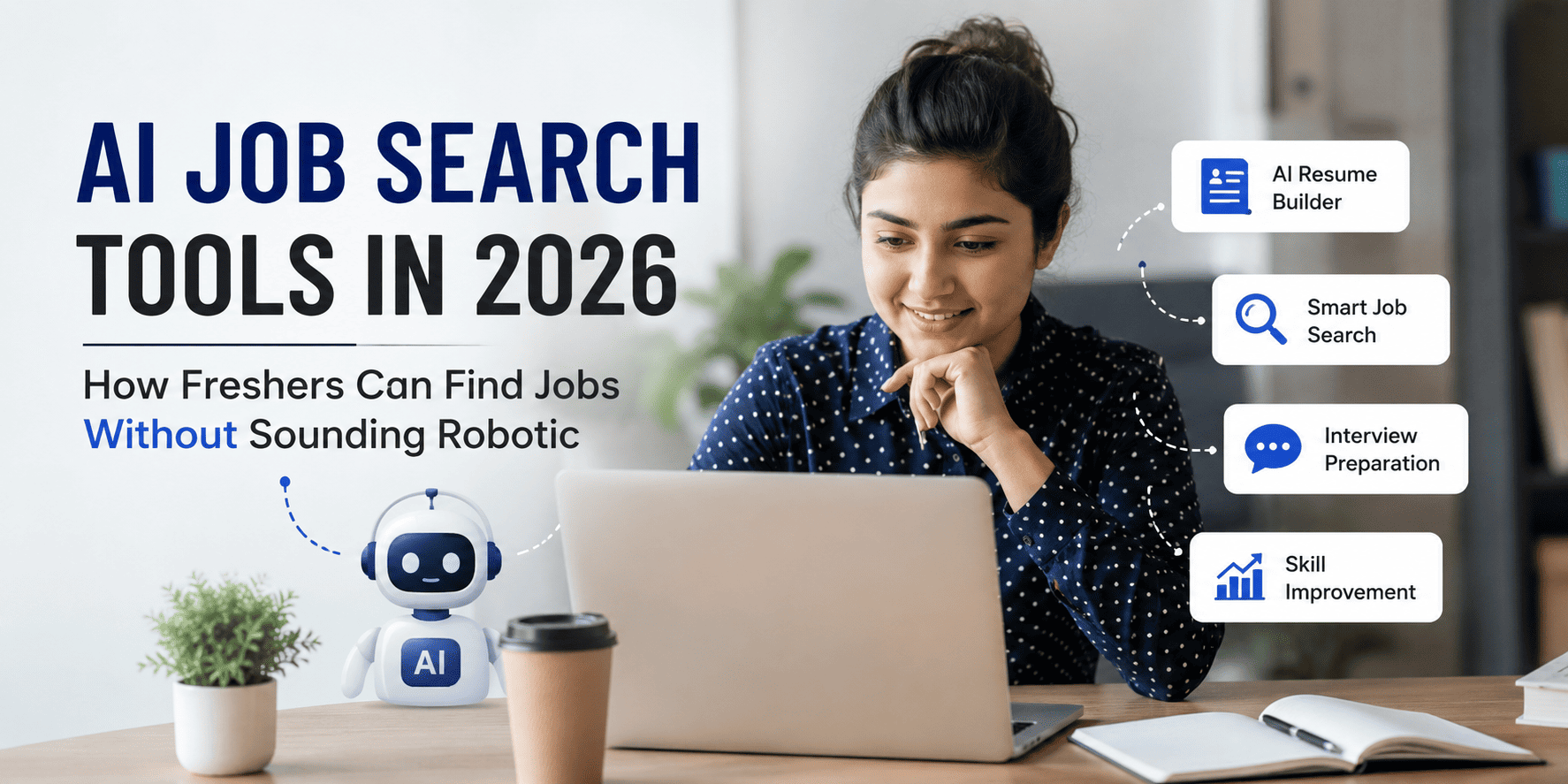
Finding your first job can feel confusing, especially when everyone around you seems to be using AI in some way. Some freshers use ChatGPT to write resumes. Some use AI resume builders. Some ask AI to prepare interview answers. And some feel scared that using AI job search tools will make their application sound fake, robotic, or copied.
If you feel the same, you are not alone.
The truth is simple: AI can help you in your job search, but it should not replace your own voice, experience, or effort. The goal is not to let AI speak for you. The goal is to use AI job search tools to organize your thoughts, improve your resume, prepare better, and apply with more confidence.
In 2026, job search is changing quickly. LinkedIn’s Work Change Report says that by 2030, 70% of the skills used in most jobs will change, with AI being one of the major reasons behind this shift. It also highlights that employers are increasingly looking at skills, not only degrees or old job titles. That means freshers need to show what they can do clearly and honestly.
What Are AI Job Search Tools?
AI job search tools are platforms or features that use artificial intelligence to help you with different parts of your job search. These tools may help you create a resume, improve your LinkedIn profile, find relevant jobs, write cover letters, prepare for interviews, or understand which skills you need to improve.
For example, some tools can scan your resume and suggest missing keywords. Some can help you practice interview questions. Some can recommend jobs based on your profile. Indeed’s AI Career Scout, for example, describes itself as an AI career coach that can help job seekers match with careers, tailor resumes, prepare for interviews, and explore jobs.
But here is the important point: AI tools are assistants, not decision-makers for your career. They can suggest better words, but they cannot fully understand your journey unless you guide them properly. They can help you polish your resume, but they cannot create real skills for you. They can prepare sample interview answers, but you still need to speak honestly in your own words.
Why Freshers Are Using AI Job Search Tools in 2026
Freshers often face one painful challenge: they have potential, but they do not always know how to present it.
You may have done a college project, an internship, a certification, or a small freelance task. But when you sit to write your resume, everything starts feeling too small. You may think, “Is this even worth adding?” or “Will recruiters take me seriously?”
This is where AI job search tools can help. They can help you convert basic experiences into clearer resume points. They can help you understand job descriptions. They can help you prepare answers for common interview questions. They can also help you save time when applying to multiple roles.
For freshers, the biggest benefit is not just speed. It is clarity.
When used correctly, AI can help you see your own skills better. It can show you how to explain your academic projects, technical skills, soft skills, internships, and achievements in a more professional way.
The Right Way to Use AI Without Sounding Robotic
Many students make one mistake while using AI: they copy the answer directly.
That is when the content starts sounding robotic.
Recruiters can usually sense when a resume summary or cover letter sounds too polished but says nothing personal. Lines like “highly motivated individual with excellent communication skills seeking a challenging opportunity” are common, but they do not tell the recruiter who you are.
Instead of asking AI to “write my resume,” give it your real details first. Tell it what project you completed, what tools you used, what problem you solved, and what result you achieved. Then ask it to improve the wording.
For example, instead of writing:
“I made a website project.”
You can ask AI to improve this with details:
“I created a college project using HTML, CSS, and JavaScript where users could search and filter products.”
A better resume point may become:
“Developed a responsive product search web page using HTML, CSS, and JavaScript, including filter functionality to improve user navigation.”
This still sounds professional, but it is based on your real work. That is the difference between using AI smartly and letting AI create fake content.
Best Ways Freshers Can Use AI Job Search Tools
1. Improve Your Resume
Your resume is often the first thing recruiters see. AI resume tools can help you improve formatting, rewrite weak bullet points, and include relevant keywords from job descriptions.
But do not add skills you do not have. If a job description mentions Python, Excel, SQL, or communication skills, only include them if you genuinely know them. A resume may get you an interview, but your honesty will help you stay confident during the interview.
For deeper resume guidance, you can also read this SJS blog: AI Resume Screening in 2026: How to Write a Resume That Still Gets Seen
2. Understand Job Descriptions
Many freshers apply without fully reading the job description. They see “fresher,” “remote,” or “good salary” and quickly apply.
AI can help you understand what a job description is really asking for. You can paste the job description into an AI tool and ask:
“What are the top skills required for this role?”
“Which keywords should I include in my resume?”
“Am I suitable for this role based on my current skills?”
“What should I learn before applying?”
This helps you apply with more focus instead of sending the same resume everywhere.
3. Prepare for Interviews
Interview preparation is one of the best uses of AI. You can ask AI to generate common interview questions for a specific role, such as digital marketing intern, HR fresher, software developer fresher, data analyst fresher, or customer support executive.
But do not memorize AI answers word by word. Interviewers do not expect perfect speeches. They expect honesty, clarity, and confidence.
Use AI to understand the structure of a good answer. Then rewrite it in your own language. Add your own project, your own learning, and your own example. This will make your answer feel real.
4. Write Better Cover Letters
Many freshers either skip cover letters or send generic ones. AI can help you create a basic structure, but your cover letter should still sound personal.
Mention why the role interests you. Mention one skill or project that matches the job. Keep it short and sincere.
A good cover letter does not need big words. It needs relevance.
5. Find Skill Gaps
AI job search tools can also help you understand what you are missing. If you are applying for data analyst roles and most job descriptions ask for Excel, SQL, Power BI, and Python, AI can help you identify these repeated skills.
This does not mean you need to learn everything at once. Start with one or two important skills. Build small projects. Add them to your resume. Confidence grows when your actions become clear.
Mistakes Freshers Should Avoid While Using AI
The first mistake is copying everything directly. AI can make your content neat, but copied content often sounds lifeless.
The second mistake is adding fake skills. This may create problems during interviews.
The third mistake is using the same resume for every job. Even with AI, your resume should be adjusted for the role.
The fourth mistake is ignoring human networking. AI can help you write better, but referrals, LinkedIn conversations, alumni connections, and genuine follow-ups still matter.
The fifth mistake is depending only on tools and not improving actual skills. AI can guide you, but it cannot replace learning.
How to Make AI-Written Content Sound Human
After AI gives you a draft, read it carefully and ask yourself:
Does this sound like me?
Is this based on my real experience?
Can I explain this in an interview?
Is it too formal or too generic?
Can I make it simpler?
Replace heavy words with natural words. Add real examples. Remove lines that feel too perfect. A human resume is not about sounding fancy. It is about sounding clear, honest, and relevant.
For example, instead of saying:
“I possess exceptional leadership abilities and a strong commitment to organizational excellence.”
You can say:
“Led a 4-member college project team and coordinated weekly task updates to complete the project before the deadline.”
The second line is simpler, but it feels more believable.
How Simplify Job Search Can Help
At Simplify Job Search, we understand that job searching can feel overwhelming, especially for freshers. You may not know which resume format to use, which jobs to apply for, or how to explain your skills clearly.
SJS is built to make that process simpler.
Whether you are improving your resume, preparing for interviews, exploring fresher jobs, or trying to understand how AI affects hiring, our goal is to help you apply with more clarity and less stress.
You do not need to sound like everyone else. You need to present your real skills in a better way.
Final Thoughts
AI job search tools can be helpful, but they should never take away your real voice. As a fresher, your story may still be small, but it is not empty. Your projects, internships, certifications, college work, communication skills, and learning attitude all matter when presented clearly.
Do not use AI to pretend. Use AI to prepare.
Use it to understand job descriptions. Use it to improve your resume. Use it to practice interviews. Use it to find skill gaps. But always add your honesty, your examples, and your own words.
You do not need a perfect start. You need a clear start.
And with the right guidance, smart tools, and consistent effort, your job search can feel less confusing and more in your control.