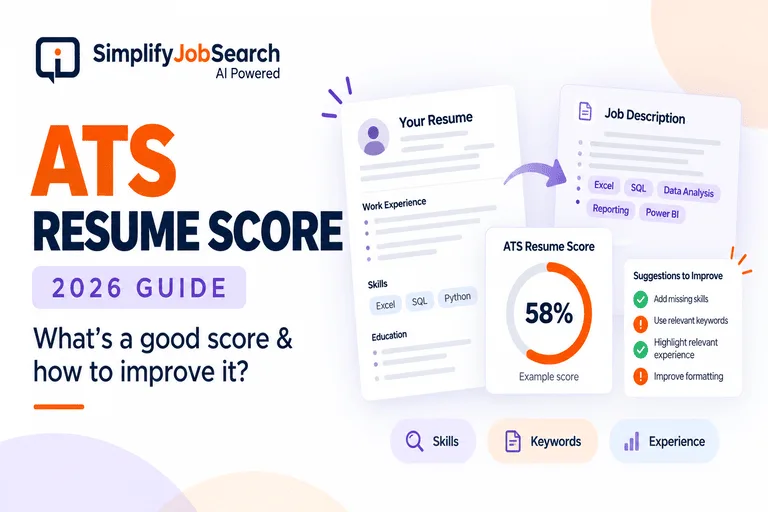
You spent 2 hours working on your resume update. Fixed formatting and added your latest skills. Went through every spelling mistake.
Then you ran it through an ATS resume checker.
Your score? 58 percent.
Now you’re thinking, does that mean my resume sucks? Should I even apply for the job?
Now before you go re-writing everything there is something you should know.
An ATS resume score is not a score on your entire career. It’s generally a tool’s estimate of how well your resume fits a particular job description. And a low score doesn’t necessarily mean you’re not qualified.
So, what’s a good ATS score in 2026? Why do the tools give different numbers? And what can you do to really improve yours?
Let’s see. Without making things overly complicated.
What is ATS resume rating?
An ATS resume score is a score given by a resume checker that tells you how well your resume matches the requirements of a job.
ATS: Application Tracking System These systems are employed by companies to collect applications, handle candidate data, and coordinate hiring.
Some hiring platforms also provide searching, filtering, screening or candidate-matching features.
But here’s the part that often gets misunderstood.
The score you get from an online ATS resume checker might not be the same score an employer gets.
Tools such as Jobscan, Rezi and other resume checkers have their own way of analysing resumes. They can look at skills relevant to the job, keywords, experience, structure and formatting.
Same resume, different tools can produce different results.
Treat these scores as feedback to improve your application, not as a prediction of whether you will be hired.
What’s a Good ATS Resume Score in 2026?
If you’ve done any online research you’ve probably seen people recommend an 80% ATS score.
Is that a good goal?
For some resume parsers, this can be a useful benchmark. But there’s no single passing score that hiring software at every company uses.
For example, a match of 80% on one checker does not mean that you will pass the employer’s screening process. And 65% is not a rejection.
A recruiter might be more interested in your actual experience, the qualifications you possess, or how you can explain what you’ve done.
A good ATS resume score is one that demonstrates a resume that is truthful, relevant and clearly written for the job you are applying for.
Instead of chasing a number, ask yourself:
- Is my resume telling the truth about my skills for this job?
- Have I told you where I have used those skills?”
- Get my experience quickly?
- What is it that we’re missing that’s important?
If you answered yes to most of these, you are already on the right track.
How Does ATS Resume Checker Calculate Your Score?
There is no single formula.
But many resume match tools look for a few common things.
1. Matching skills & keywords
Suppose you’re applying for a Data Analyst position.
The job description is SQL, Excel, Power BI and data visualisation.
But all your resume says is:
• Good knowledge of computers and data.
Even if you’ve used those tools, the resume doesn’t explain it well.
Important terms may be flagged as missing by a checker.
2. Work experience relevant
A resume checker will also look at how well your projects or past responsibilities match the job.
Actual experience with Angular or React is more relevant than a long list of unrelated technical skills for a frontend developer role.
That does not mean that unrelated experience has no value. You need to make the link clear.
3. Format Your Resume
Some tools check if your resume is easy to read and if information can be extracted from it.
A simple layout with clear headings usually works better across systems than a complicated design with multiple columns and floating text boxes.
4. Relevance of the job
A resume can be great for one job and not as relevant for another.
Someone applying for both business analyst and data analyst roles might have to emphasise different parts of the same experience.
This is why it’s more useful to check your resume against a real job description, than to check your resume without a target job in mind.
Making a Resume More Relevant: A Simple Example
Consider this position for which a fresher is applying:
Title: Junior Data Analyst
The company is looking for someone who has experience with Excel, SQL, reporting and basic data analysis.
The candidate has used Excel and SQL in a college project but their resume says:
Prior to:
Assisted with reports and worked on a college project.
There is nothing inherently wrong here. It doesn’t tell the recruiter very much.
Now think about this version:
After:
Created monthly sales reports in Excel and SQL queries to analyse order data for a college project.
The second version is a more readable story.
It describes what the candidate did, what tools they used and where they used them.
And it includes relevant skills without just throwing keywords in.
This is just an example for the sake of illustration, not a real before-after score from any ATS checker.
One important rule: Only use the improved version if it describes work you have actually done.
7 Ways to Improve Your ATS Resume Score
You don’t have to recreate your entire resume every time you’re applying for a job.
Often small, considered improvements are sufficient to help make your experience easier to understand.
1. Read the job description before you edit
Don’t jump straight into resume changes.
First, carefully read the job description. Look for repeating skills, specific tools, and responsibilities.
If a job lists Angular, TypeScript and REST APIs, ask if you have experience with them.
If you have, make that visible.
If you haven’t, don’t add them just for the sake of your score.
2. Incorporate relevant keywords naturally
Keywords are important because they help hiring teams and search tools identify the skills they want.
But repeating the word “Python” ten times won’t make you a better Python developer.
Instead of this:
“Python, python development, python programming.
Try to explain the work:
I built a Python program to clean up customer records and find duplicate entries.
The second version actually gives people a reason to think you know Python.
3. Simple resume layout
Or maybe you’re into a fancy resume template that has icons and separate columns.
There’s nothing wrong with wanting a good looking resume. But first and foremost, readability.
Use people-recognized headings like:
- Qualifications Overview
- Work Experience
- Skills
- Schooling
- Work
The University of Pennsylvania Career Services also offers general ATS-friendly formatting advice, including using relevant skills in context and standard section headings.
If you’re starting from scratch, check out our step-by-step guide to writing an ATS-friendly resume.
4. Demonstrate what you actually did
A resume that lists many responsibilities can sound like a job description.
Consider these two lines.
Weak: “Responsible for dealing with customer complaints.”
Stronger: “Addressed customer complaints via phone and email, tracked unresolved issues and communicated with support team.”
The second line gives a clearer picture of the work.
If you got real numbers, stick ’em in. If you don’t, that’s okay. Don’t make up a percentage to make an achievement sound impressive.
5. Create a duplicate for critical tasks
Sure, it may be easier to send the same resume out to each company, but that can obscure experience that’s relevant to a specific role.
You don’t need 20 totally different resumes.
Keep one current master resume and tailor the summary, skills and relevant projects for jobs you really want.
A few careful edits can turn the application into a much more focused one.
6. Don’t rewrite everything. Check for what is missing.
Sometimes the real problem is not the format of your resume.
You may have omitted an essential skill, forgot to mention a relevant project or just missed the employer’s needs.
Before making changes, compare your resume to the job description.
Use SJS Resume Gap Analysis to find your strengths, missing skills and where your resume may not be clear.
Just remember, however, that a real skill gap isn’t a missing keyword.
One may need to learn or experience. The other might just need better wording.
7. Read your resume yourself again and read it
Then, once you’ve polished your resume, run it through a resume checker again.
See what has changed and what suggestions are still valid.
But don’t stop there.
Open the last document and read it like you are hiring for that role.
Does it make your skills clear? Does that sound believable? Are you comfortable answering questions about all you have written?
Otherwise, keep editing.
Your resume needs to be readable by a human, not just a scoring tool.
Check Your Score On Your Resume With Simplify Job Search.
If you don’t know where to improve your resume, you don’t have to guess.
Simplify Job Search Resume Score Checker helps you compare your resume with a job description and provides suggestions to make it more relevant.
Here’s the lowdown:
- Upload your CV. Start with a file you already have, like one made in Word or PDF.
- Add job description. Use the real requirements of the role you’re interested in.
- Check your score and feedback. Look for missing skills, formatting issues, and places to better explain your experience.
You can use the feedback to figure out what you need to improve before you apply.
The checker is a tool of preparation. It does not know hiring rules for each and every employer and it cannot promise that a recruiter will shortlist you.
Get Your Resume Score with SJS
Typical ATS Resume Score Mistakes to Avoid
One of the most common mistakes is to get so lost in the score that you forget the real work.
We’ve all seen the resume advice that promises a perfect ATS score. It’s easy to do, especially when you’ve been applying for weeks and not heard anything.
But be on the lookout for these habits:
- Adding skills you haven’t used.
- Plagiarising entire sentences from the job description.
- Recurring keywords for each section.
- Complicated templates for the sake of looking impressive.
- This is only for jobs that score highly on the resume checker.
- Trusting every AI generated improvement without reading it
A higher match score can help you see that you’re making progress, but it can’t substitute for real qualifications or a clear explanation of your work.
Frequently Asked Questions On ATS Resume Scores
Is 80% a good ATS resume grade?
An 80% match can mean a very good alignment with a given checker. But there isn’t an across-the-board 80% threshold that all employers or ATS systems apply to all resumes.
What is a 60% ATS score? Do I get an interview with a 60% ATS score?
Yes it can be. A third party score is not going to decide whether an employer will interview you. Review the missing requirements, but don’t automatically reject based on a 60% score.
Do I have to get 100% ATS?
No. Wanting 100% can result in keyword stuffing. A readable, truthful resume with relevant experience is more useful.
Why do various ATS resume checkers provide different scores?
Tools may rank keywords, skills, experience and formatting differently. One checker’s score can’t be compared directly to another’s.
Is an ATS resume score important for freshers?
It can be useful to locate missing details. Freshers need to look at internships, college projects, coursework and skills they can really demonstrate.
Should I upload a Word or PDF resume?
First, do what your employer says. If both formats are accepted, use a clean text-based document. Make sure that the uploaded content can be read correctly. Please do not send scanned copies of resume.
Final thoughts: Your career is more than a score
Receiving a low resume score can be discouraging.
Especially when you know you’ve put in the work to build your skills.
But that figure doesn’t know how much effort was put into your college project. It doesn’t know how you solved a tough problem at work, or how fast you’ve picked up something new.
Just one piece of feed back.
Use it to improve what you can control: your wording, your formatting and the degree to which your experience matches the job.
Then go ahead.
Because the real purpose of improving your ATS resume score isn’t to get a perfect number.
It’s about helping the right employer see what you can bring to the table.