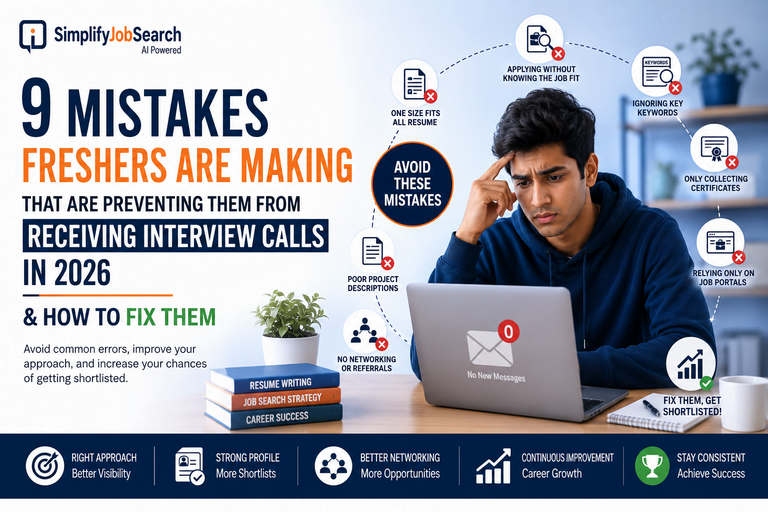
9 Mistakes Freshers Are Making That Are Preventing Them From Receiving Interview Calls in 2026 & How To Fix Them
You polish your resume, apply to a bunch of jobs, and check your email obsessively. Each new notification gives you a little hope. But after days, or weeks, no reply.
The process of not getting calls for an interview can slowly make you doubt your skills, your degree and sometimes your career choice itself. You may think that the other candidates are just better, or that you’re doing something totally wrong.
But lack of response from recruiters doesn’t mean you’re incapable.
Sometimes the job is just not a good fit. Sometimes your resume doesn’t do a good job of showcasing your strengths. Sometimes your application may be so generic that it will get lost among many similar profiles.
Freshers are not short on effort. But they are applying without any idea of how recruiters read resumes and select candidates for shortlisting.
Let’s look at nine common mistakes that might be holding back your job applications — and how to fix them without losing confidence.
Why freshers don’t get interview calls even after applying regularly
Sending out more applications does not mean you will get more interviews.
Relevance is what recruiters are looking for. They want to see if your education, skills, projects, internships and interests are a good fit for the job they are hiring for.
When the same resume is sent to marketing, HR, sales, finance and data jobs, it might not really fit any of them. It’s a true effort but the recruiter may not get a sense of how you are a fit for that specific role.
Indeed recommends tailoring your resume to the job description so that your most relevant qualifications and skills stand out to hiring managers. It can also improve the performance of your resume when an employer is using an applicant tracking system.
1. One Resume For Each Job
Using the same résumé everywhere might save you time, but it could also lower your chances of getting shortlisted.
Each role has its own requirements. You don’t want to send a resume that’s meant for a digital marketing internship to an HR, sales, or data analyst position.
You don’t need to re-write the entire document at every turn. Create one master resume and tailor the professional summary, skills, project order and important keywords to the job description.
The most important information is at the top. Displaying the link between your profile and the role quickly can help increase your chances of getting on the resume shortlist.
2. Applying without knowing if the job is a fit
Any job opening can seem suitable when it is advertised as fresher, entry level or immediate hiring. But if you apply without reading the whole description you might waste your time.
Before applying, check out the skills, education, location, work mode, responsibilities, and experience level.
You don’t have to meet all of the requirements perfectly. Most job descriptions list preferred skills that can be learned later. But there should be some reasonable relationship between what the employer needs and what you can actually deliver.
For example, if a position requires advanced SQL and you don’t have experience with SQL, it may not be the best opportunity at this time. But if SQL is just a preference and you already know Excel and data analysis, you could still be a fit.
Apply with hope, but apply with purpose.
3. Ignoring Key Resume Keywords
Most companies use an applicant tracking system, or ATS, to collect and organise applications.
When you upload a resume online, the system may parse information out such as your skills, qualifications, job titles, and certifications. A clear structure and relevant keywords make it easier to understand such information.
Read the job description carefully and highlight the repeated words. These can be tools like Excel, Python, Canva or Salesforce, or skills like customer support, recruitment, content writing or data analysis.
Only add those terms that actually represent your skills.
Don’t put keywords on your resume that you can’t articulate. Keyword stuffing can make the document unnatural and fake skills can easily make problems during interview.
To learn more about this process, check out our SJS guide to AI resume screening in 2026.
4. Writing Poor Project Descriptions
Projects are really important especially when you don’t have full-time work experience yet.
But a lot of fresher résumés mention just a project title:
University website projects
This doesn’t tell the recruiter what you made or what skills you used.
A better way to describe it would be:
Created a mobile responsive website for a college event using HTML, CSS and Javascript including event registration and schedule pages.
For each project, describe what you built, why you built it, the tools you used, and what you learned or accomplished.
You don’t have to make your project big or grand. What it has to do is prove that you can take what you know and turn it to some good use.
5. Certificates of Listing without Displaying Practical Skills
Finishing courses is a good thing. It shows that you want to learn.
But just because you have a long list of certificates doesn’t mean you can actually use those skills on the job.
If you have finished a course in Excel, make a simple dashboard. Digital marketing, learn it? Write sample campaign plan If you learned Python, make a small project. If you had an HR class, create a fake job description or interview scorecard.
Associate each major certificate with a project, case study, portfolio sample, GitHub link, presentation, or practical assignment.
One small project you can explain with confidence is worth more than ten certificates you can hardly recall.
6. Relying Solely on Job Portals
Job portals are helpful but shouldn’t be your only source for opportunities.
Some freshers just open one platform, apply to everything that is visible and keep waiting. And that can make the job search feel like a frustrating, repetitive chore.
Create a balanced routine. Use job portals, but also check out official company career pages. Connect with companies on LinkedIn, chat with your college alumni, join relevant professional communities, and stay in touch with your placement cell.
Networking is not shooting a stranger a message that says, “Please give me a job.”
It can start with a respectful conversation:
Hi, I am searching for entry level jobs in digital marketing. I saw that you work in this field and was wondering if you had any advice for someone starting out?
A real conversation can expose you to roles, companies and abilities that you may not come across in a basic job search.
7. Not Completing Your LinkedIn Profile
Your LinkedIn profile may be viewed by a recruiter after reviewing your application. If the profile is empty or vague, they may have difficulty understanding where you’re headed in your career.
Your profile needs a clear photo, professional headline, short About section, education, skills, projects, certifications and target location.
Here are some examples of headlines that are too vague to use:
Student seeking opportunities
Use a more precise term:
B.Com Graduate | Excel | Financial Analyst | Entry Level Finance Jobs
You don’t have to use fancy language in your About section. Briefly describe what you studied, what skills you are building, what projects you have completed, and what kind of opportunity you are looking for.
For freshers, a complete LinkedIn profile can supplement the information already available in the resume.
8. Repeating AI-Generated Resume Material
AI tools can help you organise your ideas, improve your grammar, and rewrite sentences that aren’t clear. But copying everything verbatim can make your resume sound generic.
Words like “highly motivated and results-driven professional” may sound impressive but they do not tell the recruiter anything specific about you.
Don’t make a sweeping statement, prove it.
Instead of writing:
Strong leadership and communication skills
Write:
Led a 4 member college project team and contributed to the final presentation before the deadline.
Share with AI your actual project details, skills, and experiences. Ask for clarification, but not for made-up details.
AI can help you explain your experience. It should never produce an experience you didn’t have.
9. Randomly Use Without Tracking or Follow Up
You may have applied for many jobs and it may be hard to remember where you applied, which resume you used or if someone replied.
Create a basic application tracker using Excel or Google Sheets Company Name, Position, Date Applied, Job Link, Version of Resume, Status, Recruiter Details, Follow-up Date
This will help you see patterns.
If you applied to 20 different roles and heard nothing back, then your targeting might need some work. If you applied to 10 similar roles and your resume was never opened or shortlisted, the resume might need stronger keywords or project descriptions.
A polite follow-up, if contact details are available, is also useful:
Hi, I recently applied for the Marketing Intern position and I wanted to confirm that I am still interested. Please let me know if you need any other information.
Make the message brief. No need to send reminders repeatedly or pressure the recruiter.
How To Increase Your Chances Of Getting Interview Calls
Before you submit your next application, take a few minutes and ask yourself:
Does this role match my skills and interests? Did I tailor my resume to this job? Is it easy to see what my strongest skills are? Have I made clear what my projects are? Can I explain everything on my resume? Is my LinkedIn profile perfect?
Applying for more jobs doesn’t always lead to more interview calls. Often it is a matter of making each suitable application more relevant and clearer.
Don’t need a perfect resume. But your resume should make it easy for the recruiter to see what you know, what you have done and why you may be a fit for the role.
A Simple 7-Day Reset for Your Job Search
Day 1
Don’t apply to everything, pick one or two target roles on day 1.
Day 2
Day 2: Read five real job descriptions and note the skills that are mentioned repeatedly.
Day 3
Day 3: Update your resume summary and skills and project descriptions.
Day 4
Day 4: Simplify the formatting and make the resume easier for recruiters and ATS software to read.
Day 5
Day 5: Fill out your LinkedIn headline, about section, skills and projects
Day Six
Day Six: List 10 companies you would like to work for and visit their official career pages.
Day 7
Day 7: Submit a few good, relevant applications that are tailored to the position.
One week might not fix your entire job search. But it can substitute random applications with a more definite plan.
How Simplify Job Search Can Assist
At Simplify Job Search, we know it can feel personal when you don’t hear back.
Most freshers are not lazy or irresponsible. They are often without clear guidance on resumes, matching job openings, interview prep, and application strategies.
SJS makes these topics easier to swallow. We want to help you express your real skills clearly, apply with better direction, and feel less overwhelmed in your job search.
You don’t have to pretend you know everything. You have to show honestly what you know and show you are ready to learn.
Final words
If you are not getting interview calls, it does not automatically mean that you are not talented or employable.
Your resume is sometimes not clear. Sometimes it’s just not the right fit for the part. Sometimes your projects and skills are not coming through strongly enough. You can work on these problems.
Don’t try to fix everything in a day.
Choose 1 target role. One resume improved. Do a real-world project. Fill in your LinkedIn profile. Submit one thoughtful application per application.
Your first job search might feel like a shot in the dark, but it doesn’t have to. With a clearer strategy and persistent effort, you can move forward with greater confidence.