You open a job portal and see 40 new openings.
A few years ago, applying to all of them could have taken your entire evening. You would open each job, read the description, upload your resume, answer the same questions and repeat the process again and again.
Now an AI apply tool promises to do most of that for you.
Set your preferences once. Upload your resume. Choose the roles you want. The tool finds openings and may even submit applications while you are doing something else.
It sounds perfect.
Why spend three hours applying to ten jobs when AI could potentially handle many more?
But there is another side to this.
If AI applies to jobs that barely match your skills, sends the same resume everywhere or answers application questions without enough context, you may end up with more applications but not necessarily more interviews.
That is becoming one of the biggest questions around AI job search in 2026:
Should you apply to more jobs automatically, or spend more time making fewer applications stronger?
The useful answer sits somewhere in the middle.
What Does AI Apply Mean?
The phrase AI apply generally refers to tools that use artificial intelligence or automation to help with the job application process.
Depending on the platform, the tool may:
- Find jobs based on your experience and preferences
- Match your resume with job descriptions
- Fill repeated application fields
- Suggest answers to common questions
- Tailor parts of your resume
- Create a cover-letter draft
- Track applications
- Submit applications automatically
Not every tool works the same way.
Some AI tools simply help you prepare an application faster.
Others go further and automatically submit applications without requiring you to review every individual job.
That difference matters.
There is a big difference between:
AI-assisted applying:
AI finds relevant jobs, helps tailor your application and saves repetitive work, but you make the final decision.
And:
Fully automated applying:
The system decides which jobs meet its rules and submits applications with little or no involvement from you.
The second approach gives you much more speed. It also gives you much less control.
Why AI Auto Apply Has Become So Popular
The attraction is easy to understand.
Job hunting can become exhausting.
You find an interesting role, create an account, enter your work history even though it is already on your resume, answer several questions, upload files and then discover another similar application waiting on the next website.
After doing this repeatedly, almost anyone starts thinking:
There has to be an easier way.
Candidates are already turning to automation.
Greenhouse’s 2025 Workforce & Hiring Report found that 22% of candidates surveyed used bots to apply to jobs automatically, rising to 31% among Gen Z respondents.
At the same time, application volume has increased sharply. Greenhouse’s 2026 hiring benchmark says application volume rose 111% between 2022 and 2025.
So the behaviour makes sense.
When jobs receive applications quickly and competition feels intense, candidates naturally look for ways to move faster.
But speed creates a new problem.
If everyone can apply faster, simply applying more stops being much of an advantage.
Does AI Apply Actually Get You More Interviews?
Not automatically.
Using AI to find and apply for relevant jobs can absolutely make your search more efficient.
But there is an important difference between:
sending more applications
and
sending more relevant applications.
LinkedIn research found that 37% of job seekers said they were applying to more jobs than ever but hearing back less. The same research found that 73% of HR professionals said fewer than half of the applications they received met all of the criteria in the job listing.
That tells us something important.
The problem is not always a shortage of applications.
Sometimes there are already too many applications that do not fit the role well enough.
Imagine you are a fresher looking for a Data Analyst position.
Your skills are:
Excel
SQL
Power BI
Basic Python
An auto-apply tool finds 100 openings containing words such as “data,” “analytics” or “business intelligence.”
But some require five years of experience.
Some require advanced machine learning.
Some are Data Engineering jobs.
Some are in locations where you cannot work.
If the tool applies to all 100, your application count looks impressive.
Your actual opportunities may not.
A good AI job search should help reduce irrelevant applications, not simply increase their number.
Where Auto Apply Can Actually Save You Time
Auto apply is not useless. Used carefully, it can remove a lot of repetitive work.
1. Finding Relevant Jobs
Searching five job portals every day takes time.
AI can scan opportunities based on your role, skills, experience, location and preferred work type.
This is one of the most useful applications of AI because it reduces the amount of searching you have to do manually.
Indeed, for example, says its AI-powered matching systems recommend jobs based on job-seeker information and employer requirements. Its testing of improved AI matching context resulted in a 20% increase in started applications and a 13% uplift in interviews and hires.
That does not mean every AI recommendation leads to an interview.
It does show why better matching is more useful than blindly increasing application volume.
2. Removing Repetitive Form Filling
Your phone number has not changed.
Neither has your college degree.
You should not need to manually type the same basic information into 25 applications.
Automation is very useful for repetitive information that does not change from one application to another.
3. Helping You Understand Job Fit
Before applying, AI can compare your profile with a job description and highlight:
- Skills you already have
- Skills you are missing
- Experience requirements
- Important keywords
- Location or work-mode requirements
That allows you to make a better decision before spending time on the application.
4. Helping You Tailor Application Material
AI can also help adjust the parts of your resume that should change between applications.
It can identify relevant skills, reorder project descriptions and help you focus your resume on the requirements of a particular role.
The important word here is help.
AI should improve how clearly you present your actual experience, not invent experience to create a better match.
Where Blind Auto Apply Starts Going Wrong
The problem begins when the goal changes from:
“Help me apply efficiently.”
to:
“Apply to as many jobs as possible.”
1. You Start Applying to Jobs You Would Never Choose Yourself
An automated tool follows filters.
It does not always understand your priorities as well as you do.
A role might technically match your title but involve completely different work.
The salary may be wrong.
The location might not work.
The company may require night shifts.
The job could ask for skills that only loosely overlap with yours.
Reading the job description for even one minute can prevent many unnecessary applications.
2. The Same Resume Gets Sent Everywhere
This is one of the biggest risks.
Suppose you are targeting:
Business Analyst
Data Analyst
Operations Analyst
There is some overlap between them.
But the skills each employer prioritises can be different.
If the same generic resume goes to every opening, recruiters may struggle to see why you fit their particular role.
This is also one reason freshers can apply repeatedly without receiving calls. Our guide on Interview Calls for Freshers in 2026 explains how one-size-fits-all resumes and applying without checking job fit can reduce the clarity of an application.
3. AI Can Answer Something Incorrectly
Some job applications ask questions such as:
Do you have three years of SQL experience?
Are you legally authorised to work in this country?
Are you willing to relocate?
What is your expected salary?
Can you work night shifts?
These are not questions you want a bot guessing.
One incorrect answer can create problems later, even if the mistake was caused by automation.
4. You Can Lose Track of Where You Applied
Sending 100 applications sounds productive until a recruiter calls and you cannot remember:
the company,
the job,
the description,
or why you applied.
That is not a great start to a recruiter conversation.
Whatever AI apply tool you use, maintain an application history that includes the company, role, date, resume version and current status.
5. Some Platforms Restrict Automated Activity
This point is easy to overlook.
Not every platform allows third-party tools to automate actions on its website.
LinkedIn says it does not permit unauthorised third-party software or browser extensions that automate activity on LinkedIn, and violations can lead to account restrictions. LinkedIn has also introduced Easy Apply limits, explaining that application quality often matters more than the number submitted.
Before connecting an automation tool to any job platform, check that platform’s current rules.
AI Auto Apply vs AI-Assisted Job Search
The difference becomes clearer when you compare the two approaches.
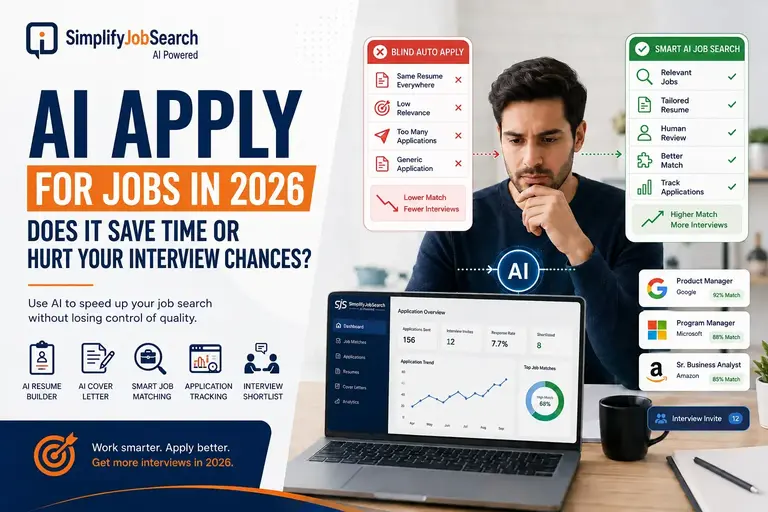
| Blind Auto Apply | AI-Assisted Job Search |
|---|---|
| Apply to maximum jobs | Find the most relevant jobs |
| Same resume may go everywhere | Resume is adjusted when needed |
| Little job-description review | Job fit is checked first |
| AI may make decisions automatically | Candidate keeps final control |
| Success measured by applications sent | Success measured by quality opportunities |
| High speed, lower control | Good speed with better control |
For most job seekers, the second approach is safer and more useful.
You still get the benefit of AI.
You just do not give away every decision.
A Better Way to Use AI Apply Tools in 2026
Here is a simple routine.
Step 1: Decide What You Are Actually Looking For
Choose one or two target roles.
For example:
Frontend Developer
Junior Software Engineer
or:
Digital Marketing Executive
Social Media Executive
Your search becomes much easier when AI has a clear target.
Step 2: Set Strong Job Filters
Give the tool information about:
- Target job title
- Experience level
- Preferred location
- Remote, hybrid or office preference
- Salary expectations where relevant
- Important skills
- Industries you want
- Industries you want to avoid
Better input usually creates better recommendations.
Step 3: Let AI Find Opportunities
This is where automation can save serious time.
Instead of manually checking many websites, let AI surface jobs that appear relevant.
Step 4: Check the Match Before Applying
You do not need a 30-minute investigation for every vacancy.
Spend a minute checking:
Do I understand this role?
Do I meet the important requirements?
Would I actually accept an interview for this job?
If the answer is no, do not apply simply because the button is available.
Step 5: Tailor the Important Parts
You do not need to rebuild your resume from zero for every application.
Keep a strong master resume.
Then adjust things such as:
- Summary
- Relevant skills
- Project order
- Experience bullets
- Important job-description keywords
If a cover letter is required, AI can create the first draft, but personalise it before sending. Our guide on AI Cover Letters in 2026 explains how to use AI without sending a generic application.
Step 6: Review Before Submission
Check:
Company name
Job title
Contact information
Experience questions
Salary questions
Work authorisation
Resume version
Cover letter
Thirty seconds of checking can save an awkward conversation later.
Step 7: Track the Application
Automation should make your search more organised, not more confusing.
Track every application so you know exactly what happened after you applied.
Should Freshers Use AI Auto Apply?
Yes, but freshers should probably be even more careful with full automation.
When you have limited professional experience, your projects, internships, coursework and practical skills need to be presented clearly.
A recruiter may already be choosing between hundreds of entry-level candidates.
Sending the same basic resume to every vacancy does not give them much reason to stop at yours.
Instead, use AI to help you:
understand the role,
identify important skills,
improve your project descriptions,
tailor your resume,
prepare a cover letter,
and discover more suitable openings.
If you are new to using artificial intelligence for applications, our broader guide to AI Job Search Tools in 2026 explains how AI can help with resumes, skill gaps, interviews and job discovery without making your application sound robotic.
How Simplify Job Search Fits Into This Approach
At Simplify Job Search, we think the useful question is not:
“How many applications can AI send for me?”
It is:
“Can AI help me find better opportunities and prepare a stronger application faster?”
SJS helps job seekers work through different parts of that process from one platform.
You can discover AI-curated job recommendations, check how your resume aligns with a role, identify missing skills and keywords, create a job-focused resume and generate a tailored cover-letter draft.
The idea is to reduce repetitive work while still giving you control over what represents you.
Because sending an application takes seconds.
Getting the right application noticed is the harder part.
So, Does AI Apply Save Time or Hurt Your Chances?
It can do either.
Used well, AI apply tools can save hours of searching, form filling and repetitive preparation.
Used carelessly, they can turn your job search into a giant spreadsheet full of jobs you barely remember applying to.
There is no prize for having the highest application count.
The goal is an interview.
And an interview usually starts with a recruiter being able to understand one simple thing:
Why does this person make sense for this job?
AI can help you find that opportunity faster.
It can help you prepare the application.
It can help you remove repetitive work.
But you should still decide where your name and resume are being sent.
Automate the repetition. Keep control of the decision.
That is probably the smartest way to use AI for job searching in 2026.
Frequently Asked Questions
Is AI apply safe to use for job applications?
It depends on the tool and the platform where it operates. AI can safely help with job matching, resume tailoring and application preparation, but you should review permissions before giving third-party tools access to job-platform accounts. Some platforms restrict unauthorised automation.
Does auto applying to more jobs increase interview chances?
Not necessarily. More applications may create more opportunities only when the jobs are reasonably relevant to your skills and experience. Sending large numbers of poorly matched applications can increase your application count without improving your interview rate.
Can recruiters tell that I used AI to apply?
A recruiter may not know which specific tool you used. What is easier to notice is a generic resume, inaccurate information, vague answers or an application that does not fit the job. Focus less on hiding AI and more on making sure the application is accurate and relevant.
What is the best way to use AI job search tools?
Use AI to discover relevant opportunities, understand job descriptions, compare your resume with the role, reduce repetitive work and improve application material. Keep the final decision and factual review with yourself.
Should I use the same resume with an auto-apply tool?
A strong master resume is useful, but the exact same resume may not be ideal for every role. For jobs you genuinely want, adjust the most relevant sections so the recruiter can quickly understand how your experience connects with the vacancy.