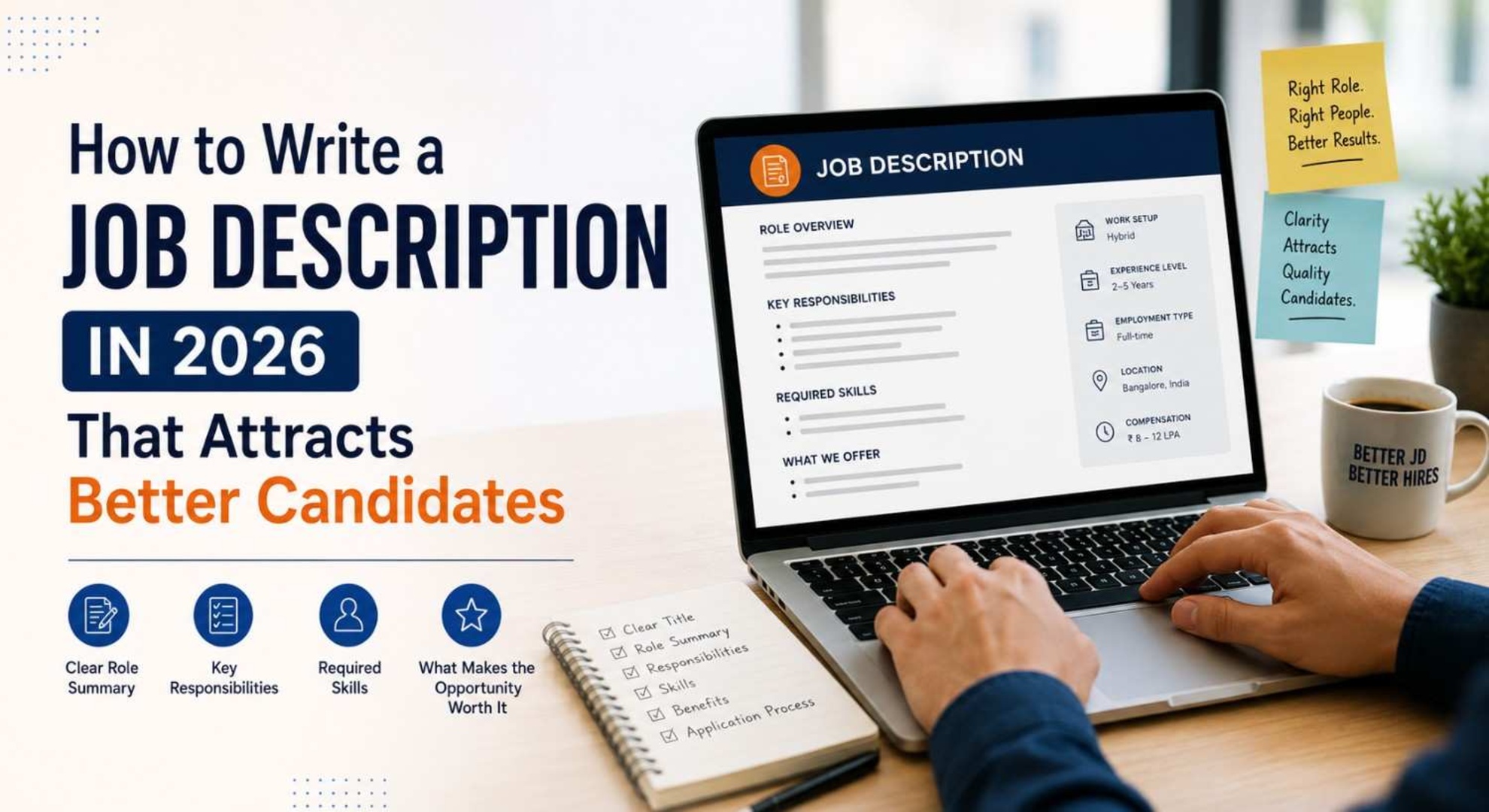
If you are hiring and the applications feel either too random or too weak, it is easy to think the market is the whole problem. Sometimes the market is difficult. But sometimes the problem starts much earlier — with the job description itself.
A vague or overloaded job description can attract the wrong candidates, confuse the right ones, and slow down your hiring team before interviews even begin. In 2026, that matters even more because candidates are scanning opportunities quickly, recruiters are dealing with volume, and platforms are using job description content more actively in matching and targeting. Indeed says job posts between 700 and 2,000 characters can receive up to 30% more applications, and LinkedIn says the job description now helps power AI-based applicant targeting and candidate surfacing.
So if you want better-fit applicants, faster screening, and less hiring noise, learning how to write a job description properly is no longer a minor task. It is one of the most practical hiring advantages you can build.
This guide breaks the process down in simple language so recruiters, founders, and hiring managers can write clearer, more candidate-friendly JDs that actually improve hiring outcomes.
Why a good job description matters more in 2026
A lot of hiring teams still treat the job description as an admin task. Something to fill in, post quickly, and move on from. But a good JD is not just a formal document. It is one of your first and strongest hiring filters.
It shapes who sees the role, who understands it, and who decides to apply. LinkedIn’s recruiter guidance says strong postings should include a straightforward, keyword-driven description, clearly defined responsibilities, compensation and benefits, growth opportunity, workplace flexibility, and culture. Workable also emphasizes that a good job description should use a clear title, speak directly to candidates, describe the actual work, and sell both the job and the company.
That means a JD does more than “describe a vacancy.” It influences:
- search visibility
- candidate quality
- application volume
- screening speed
- employer brand
If your JD is weak, the hiring funnel often gets weak before it even starts.
If you want to understand how AI is reshaping hiring workflows beyond job descriptions, read: The Real Impact of AI in Hiring in 2026.
What a job description is actually supposed to do
A good job description should answer a few basic candidate questions very quickly:
What is this role?
What will I actually do?
What skills do I truly need?
Who is this role really for?
Why should I care about this opportunity?
That sounds simple, but many JDs miss this entirely. They become long, generic lists that feel copied from an old document instead of written for a real person.
LinkedIn’s examples and recruiter guidance repeatedly stress that the best job descriptions do not just list requirements. They help candidates imagine themselves in the role and understand why the opportunity is worth exploring.
So the goal is not to sound formal. The goal is to make the role clear.
How to write a job description: a simple structure that works
1. Start with a clear, searchable title
This sounds basic, but it is where many JDs go wrong.
If your title is confusing, overly creative, or too internal, the right candidates may never find it. Titles like “Sales Rockstar,” “Growth Ninja,” or “Customer Success Wizard” may look fun internally, but they reduce search clarity.
Indeed recommends a targeted title, and Workable also advises using a clear title that candidates actually recognize. That matters for discoverability and for candidate trust.
A better approach is:
- Marketing Executive
- Data Analyst
- HR Recruiter
- Frontend Developer
Clarity beats cleverness here.
2. Add a short role summary
Before you get into long details, give the candidate a simple overview.
In 2–4 lines, explain:
- what the role is
- what the person will mainly do
- why the role matters
This helps candidates decide quickly whether the job is relevant. It also helps your hiring team align on the core purpose of the role.
Example:
“We’re hiring a Data Analyst to help turn business data into clear reporting and decision support. This role will work across dashboards, stakeholder requests, and ongoing performance tracking.”
That is much stronger than starting with a giant block of company language.
3. List real responsibilities, not vague tasks
Candidates should be able to picture what their day or week might look like.
LinkedIn and Indeed both recommend clearly defined responsibilities, and Workable advises describing actual tasks rather than hiding behind vague statements.
Good:
- Build weekly performance reports in Excel and Power BI
- Coordinate interview scheduling across hiring teams
- Write and optimize paid social ad copy
Weak:
- Handle day-to-day activities
- Support team requirements
- Work on assigned tasks as needed
The second type says almost nothing. The first type helps candidates self-select properly.
4. Separate must-haves from nice-to-haves
This is one of the easiest ways to improve candidate quality.
When every skill is written as mandatory, good applicants often drop off unnecessarily. This is especially true for women, career switchers, and early-career candidates who may meet most of the role but hesitate when the JD feels too rigid.
A cleaner structure is:
- Must-have skills
- Nice-to-have skills
That makes screening easier later and makes your JD feel more realistic.
5. Be specific about tools, level, and work setup
Candidates want practical clarity.
Mention:
- tools or platforms
- experience range if relevant
- remote, hybrid, or in-office
- time zone if needed
- full-time, internship, contract, or part-time
LinkedIn specifically recommends including workplace flexibility, and candidate-focused postings increasingly perform better when they reduce guesswork.
If your job requires:
- HubSpot
- SQL
- Figma
- evening overlap with the US team
- three days in office
say that clearly.
This saves time for everyone.
6. Include compensation if possible
More candidates now expect salary clarity, and recruiter platforms increasingly encourage transparency. LinkedIn explicitly lists compensation and benefits as key details that make job postings more discoverable and attractive.
You do not always need to publish an exact number if your company policy does not allow it. But when possible, a range helps:
- reduce mismatched applicants
- improve trust
- save time later in the funnel
Salary clarity is no longer just a “nice to have.” It is part of candidate experience.
7. Make the opportunity worth applying for
A JD should not only ask. It should also attract.
Too many job descriptions read like a list of demands. But strong candidates are also evaluating you.
Workable recommends selling both the job and the company. LinkedIn similarly highlights culture, growth, and flexibility as important parts of a strong posting.
You can do that by briefly explaining:
- what the team is building
- what the person can learn
- why the role matters
- what kind of growth or ownership is available
- what makes the company environment appealing
You do not need hype. You need honesty.
8. End with a clear application process
Do not make candidates guess what to do next.
Say:
- what to submit
- whether a portfolio is needed
- what the next step looks like
- how shortlisted candidates will be contacted
This lowers friction and makes your process feel more professional.
Common mistakes recruiters make in job descriptions
A lot of weak JDs follow the same patterns.
They use too much jargon.
They ask for every possible skill instead of the real essentials.
They bury the role in long paragraphs.
They copy an old JD that no longer reflects the actual work.
They hide work setup details.
They make entry-level roles sound like senior roles.
They describe the company too much and the actual work too little.
Indeed’s and Workable’s guidance both push in the opposite direction: be concise, scannable, specific, and candidate-friendly. Skills-based JD guidance from Indeed also emphasizes readability, negative space, and careful proofreading.
So if your JD feels heavy, generic, or overbuilt, simplify it.
What good job description examples usually do better
Strong job description examples usually have a few things in common.
They use a recognizable title.
They explain the role early.
They keep responsibilities readable.
They separate actual needs from wish-list items.
They help the candidate imagine the job.
They sound like a human wrote them.
LinkedIn’s job description examples emphasize that strong JDs support employer brand and inspire candidates to act. Indeed also maintains a large library of examples and templates because hiring teams often need structure, not just theory.
That is a useful reminder: your JD does not need to be perfect. It needs to be clear enough that the right person can say, “Yes, this sounds like me.”
How better JDs improve the full hiring process
A better job description does not only help sourcing.
It also improves:
- application relevance
- screening efficiency
- interviewer alignment
- candidate expectations
- hiring-manager clarity
And in 2026, it can even improve platform performance. LinkedIn’s latest hiring product updates say the job description is being used to generate targeting criteria for AI-powered applicant targeting, which means JD quality can directly influence candidate reach.
That makes the JD more strategic than ever.
Final thoughts
If you are struggling to attract better candidates, do not start by assuming the market has no talent. Start by looking at the job description.
A strong JD is clear, searchable, honest, and useful. It tells the right candidate what the role is, what matters, and why the opportunity is worth their time. It also helps the wrong-fit candidate self-select out — which is just as valuable.
So if you want to know how to write a job description that actually improves hiring, remember this:
Use a clear title.
Write a short summary.
List real responsibilities.
Separate must-haves from nice-to-haves.
Be transparent about setup and pay where possible.
Write like a human.
Because better hiring often starts with better writing.
And sometimes, you do not need more applicants. You need better-fit applicants.